
Outdoor
Removing a backyard tennis or sport court in Oakville
- sport court
- tennis court
- backyard
A backyard tennis or sport court is a big commitment of space. When the kids have moved on, or the new owners want a pool or a garden instead, it becomes a large flat area that is surprisingly hard to get rid of.
There's more to a court than the surface you play on. Here's what's involved in taking one out.
What a court is made of
Most residential courts are built in layers, with a few extras around the edge:
- An asphalt or concrete playing surface.
- A compacted granular base underneath.
- Perimeter fencing, often tall chain link.
- Light standards for evening play.
- Nets, posts and sometimes basketball hoops.
- Drainage along the edges or under the surface.
Fence posts and light standards
Tall fencing and light poles sit on deep concrete footings. Those footings are broken out or pulled, not just cut at the surface, so they do not get in the way of whatever comes next. Fence fabric and posts are separated for metal recycling.
Nets, posts and hoops come out first, since they are usually easy to lift and may be worth passing on to a school, a club or a neighbour with young players.
Breaking the surface and the base
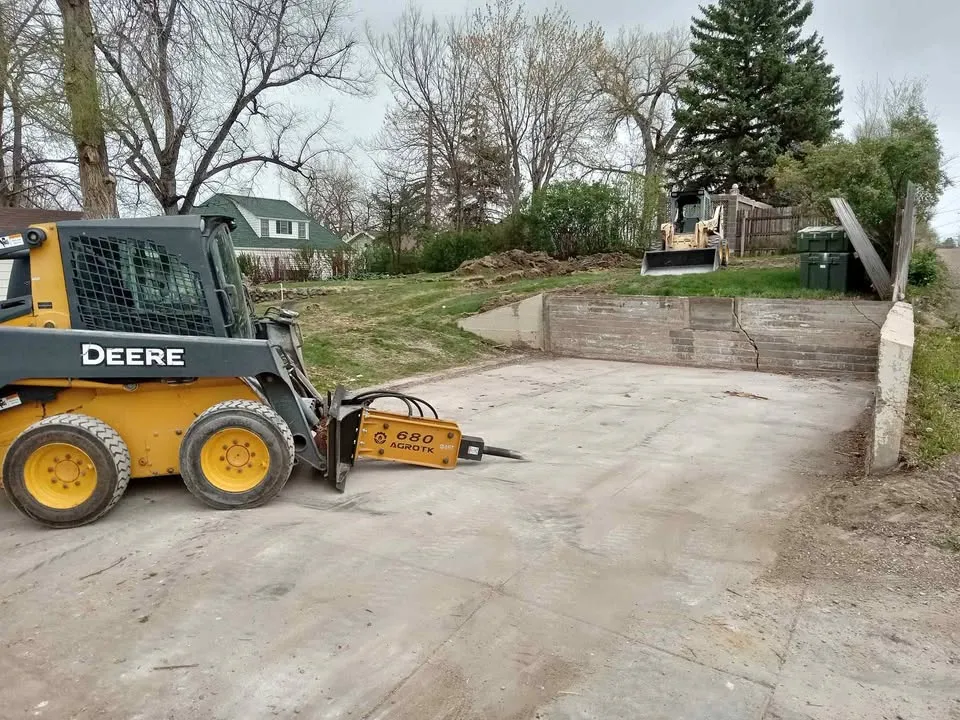
The surface is sawcut into sections where needed, then broken and loaded out. Our concrete removal service covers the equipment and hauling.
The granular base may stay if the area will become a patio, a driveway extension or a pool deck. If the space is becoming lawn or garden, the base usually comes out so topsoil can go in.
Lighting circuits
Court lighting runs on its own electrical circuit. An electrician disconnects and makes it safe before the poles come down. Buried cable runs are then removed or abandoned as the electrician directs.
Trees around the court
Courts are often ringed by mature trees planted for shade or privacy. Roots may run under the edge of the surface. The Town's Private Tree Protection By-law applies to those trees, and our tree guide explains how. Breaking near roots is done carefully.
Grading afterward
Removing a court changes the grade of a large area. Depending on how much fill goes in or comes out, the Town's Site Alteration By-law may apply; our guide on site alteration and demolition covers when. The final grade should drain away from the house and not onto neighbours.
When to bring in a professional
Removing a court is not a do-it-yourself job. It needs breaking equipment, trucks, an electrician for the lights and a plan for the grade. Bring your landscaper or designer in early so the base is handled the way the next use needs.
Getting your yard back
A court comes out in a predictable order: lights, fence, surface, base, grade. Bolan Group Demolition Oakville handles it through our concrete work and site clearing. Request a free estimate to plan the space that comes next.
Frequently asked questions
- Can the court base be reused for a patio or pool deck?
- Often, yes. A compacted granular base can make a good start for a new hard surface if it is in good condition and at the right level. Your landscaper or pool builder decides, and the removal leaves the base in place or takes it out to match their plan.
- What happens to the fencing and light poles?
- They are taken down after the electrician disconnects the lights. Posts and poles are pulled with their concrete footings, and the metal is separated for recycling. The footings are broken out rather than cut at grade so nothing is left in the way of the new yard.
- Will removing the court hurt nearby trees?
- It can if the work is careless. Roots often extend under the court surface, so breaking near the edge is done with care and machines stay off root zones where possible. Trees covered by the Town's Private Tree Protection By-law need the same attention as on any demolition site.
- Do I need a permit to remove a tennis court?
- Removing the court surface itself generally does not need a demolition permit, but regrading a large area may fall under the Town's Site Alteration By-law, and some light standards may need an electrical permit to disconnect. Check with the Town of Oakville before the work if you are unsure.