
Service
Commercial Strip-Out in Oakville
A commercial strip-out removes a previous tenant's walls, ceilings, flooring and fixtures so a space can be rebuilt or handed back to the landlord. It is for property managers, landlords, tenants and general contractors with commercial units in Oakville and across Halton Region. We coordinate with building management around access and working hours.
Plan the wider project
Choose the change you are planning. These guides connect the removal boundary to retained spaces and the work that follows.
Commercial layouts
- Taking over an unfinished demolition package
- Renovating warehouse offices: define the demolition package for the new fit-out
- Preparing an office floor for a new fit-out: selected removals or a wider reset?
- Combining or dividing leased units: define the interiors before demolition
- Office partitions: retain, relocate or demolish?
- Compare the demolition needed in two commercial premises
Hospitality spaces
Shops and operators
- A retail refurbishment programme needs a demolition scope for each store
- Ending a temporary retail fit-out: recovery, supplier teardown and demolition
- Salon and spa renovation strip-out
- Gym and studio renovation demolition
- Automotive showroom refurbishment: the ordinary demolition package
- Grocery-store refurbishment after specialist equipment removal
- Commercial laundry refit: when does the building need demolition?
Shared building interiors
- Include the staff washroom deliberately in an office refurbishment
- Refurbishing a closed clinic’s reception and ordinary room interiors
- Common-area demolition for a condominium refurbishment
- Demolition packages for several lawfully vacant apartments
- Training-centre renovation: changing the classroom layout
- Demolition within a vacant childcare-premises renovation
- Community-facility refurbishment: ordinary rooms and retained building features
- Pool-area refurbishment: ordinary interiors around a retained pool
- Theatre and cinema refurbishment: defining ordinary interior demolition
Commercial removal services
Concrete in a larger project
Connected home renovations
How we do it
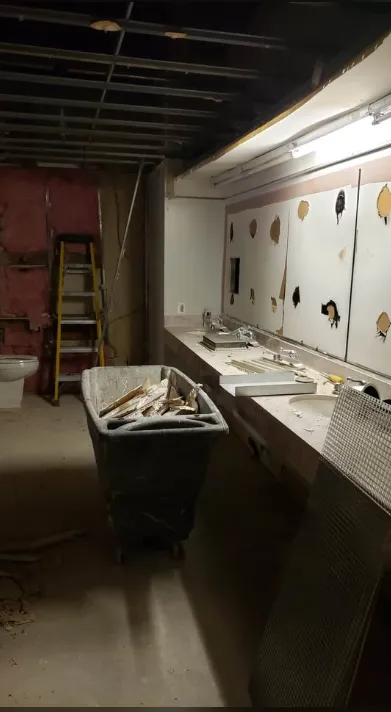
The photos in this section come from office and commercial interiors: drywall torn from steel studs, suspended ceilings taken down to the grid and ductwork, corridors cleared back to brick and block, and rooms reduced to their stud frame before the partitions come out. That is the base building condition most landlords and fit-out contractors ask for.
Commercial work starts with the lease or the fit-out drawings. We confirm which items belong to the base building and must stay, such as sprinklers, fire separations, exit signage and mechanical risers, and which tenant improvements are coming out. Those are marked on site before work starts.
Building management usually sets the rules for loading docks, elevators, working hours and noise. We work within them, and in multi-tenant buildings we keep corridors and shared washrooms clear and protected. Electrical is made safe by a licensed electrician before walls and ceilings are opened.
Under OHSA section 30, the owner must provide a designated substance survey before a commercial project is tendered, and many older commercial buildings in Oakville have asbestos in ceiling tiles, drywall compound or pipe insulation. That material is removed first, under O. Reg. 278/05. Where a project meets the Ministry of Labour's threshold, a Notice of Project is filed before work begins.
We keep a clear record of what was removed and what was left in place, so the landlord, tenant and next contractor all have the same picture. If something unexpected turns up behind a wall or above a ceiling, such as abandoned wiring or an old fire separation, we stop and flag it rather than guessing.
Metal studs, ceiling grid and wiring are separated for recycling. The space is handed over swept, with debris removed from the building and the loading area left clean.
What to expect
Scope review
We review the lease or drawings and walk the space with you or the property manager.
Building coordination
Access, elevator use, hours and protection are agreed with building management.
Surveys and notices
The designated substance survey is reviewed and any abatement or Ministry notice is completed first.
Strip-out
Ceilings, partitions, flooring and fixtures are removed, with metals separated for recycling.
Handover
The unit is left swept and at the agreed base-building condition.
Selected scope photographs
Commercial strip-out Commercial strip-out Commercial strip-out Commercial strip-out
Questions we hear
- Can you work evenings in an occupied building?
- Building management often asks for noisy work outside business hours. Oakville's noise by-law prohibits construction noise from 7 p.m. to 7 a.m. Monday to Saturday and on Sundays and statutory holidays, so any after-hours work needs an exemption permit or has to be quiet work.
- What does base building mean?
- It is the condition set out in your lease, usually with tenant walls, ceilings and finishes removed but the building's structure, fire protection and core services left in place. We work from the lease wording or the landlord's written description.
- Who provides the designated substance survey?
- The owner, under OHSA section 30. In a leased unit, that is often arranged through the landlord or property manager before contractors are invited to price the work.
- Do you remove flooring and adhesive?
- Yes. Carpet, vinyl tile and the adhesive under it can be removed. Older flooring and mastic are checked in the survey for asbestos first.
Plan the work at your location
The scope starts with the building; access and municipal preparation depend on the address. Explore Oakville planning, Burlington clearances or the full regional directory.
Find preparation answers in our demolition guides.
Questions before choosing this scope
Talk to us about your project
Tell us what needs to come down and where. We'll arrange a site visit and send you a written scope. Calls are answered 24/7.
WSIB clearance on record. $5M commercial general liability coverage. Established 2006.